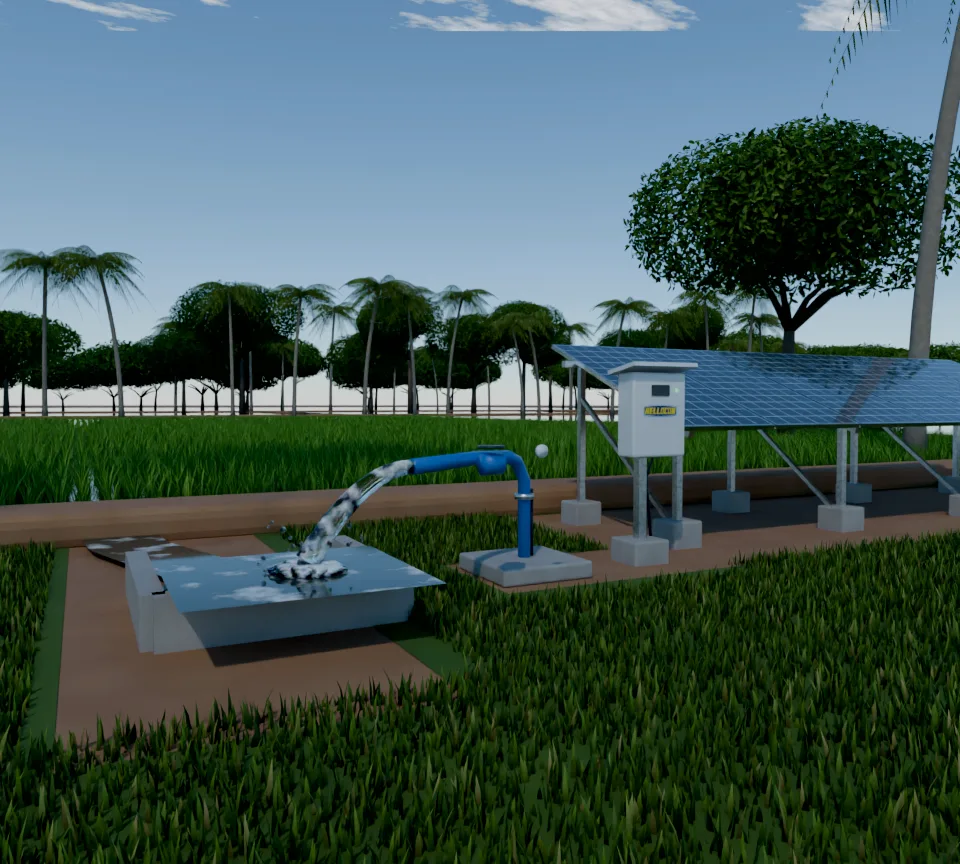
Suitable for irrigation, community water and institutional supply. Scope: pump, controller and solar-duty assessment for the source and total head. Brief: water-source yield, daily demand, lift, pipe route and location. Next step: request a duty assessment; flow visuals certify neither output nor water quality.
A solar array on a GI structure powers a pump through its HELLOCON controller; water gushes from the delivery pipe into a chamber and flows into a paddy field.
THE SOLUTION
System design: Solar water pumping
HELLOCON supplies solar water pumping solutions for drinking water and agricultural irrigation. The solar water pumps are purchased and traded for supply, not manufactured by HELLOCON. A solar array powers a controller and pump, while the design accounts for water source, head, demand and storage.
Use sunlight for daytime pumping
Reduce reliance on diesel or grid-powered pumping
Store water for use beyond generation hours
Components illustrated in this system
01Solar array
02Pump controller
03Pump and motor
04Pipework and protection
01 · THE DESIGN BRIEF
Solar water pumping: applications and equipment
01APPLICATIONS
Where it works
Agricultural irrigation
Community drinking water
Rural and institutional supply
02SYSTEM ARCHITECTURE
What it brings together
Solar array
Pump controller
Pump and motor
Pipework and protection
Water storage, where specified
03ENGINEERING
What we assess
Total dynamic head and water demand
Water source yield and pumping conditions
Daytime operation and storage requirements
Final configuration, component standards, test documents and warranty terms are confirmed in the project-specific proposal and technical documentation.
02 · FROM BRIEF TO OPERATION
From survey to commissioning: Solar water pumping
01
Step 1: Discover
Understand the site, the load and your energy goals.
02
Step 2: Engineer
Assess shading, system configuration and electrical integration.
03
Step 3: Deliver
Coordinate procurement, site execution and installation.
04
Step 4: Commission
Test, document and bring the system into service.
05
Step 5: Support
Maintain performance through operation and maintenance.
PLANNING GUIDANCE
Planning solar water pumping in Odisha
01Select from water demand and total head
02Solar pumping programmes in Odisha
03Plan operation and maintenance
01 / 03
Select from water demand and total head
Pump selection needs the water source, expected flow, total dynamic head, source yield and operating pattern. Horsepower alone does not define a suitable installation. Explain whether the duty is irrigation, community drinking water or another application, and identify pipework and storage requirements. The design should connect the pump, controller and photovoltaic array to those conditions.
02 / 03
Solar pumping programmes in Odisha
For agricultural assistance, consult the official Odisha PM-KUSUM portal (opens in a new tab) and Soura Jalanidhi guidance (opens in a new tab). Application windows, approved suppliers and assistance conditions must be checked through the relevant authorities. HELLOCON can discuss the engineering and supply requirements for your site. A drinking-water or institutional system has a different brief from an irrigation application.
03 / 03
Plan operation and maintenance
Many solar pumps operate during daylight and store water for later use. Battery storage depends on the configuration rather than being mandatory. Discuss source protection, controls, dry-run protection where specified, tank arrangements and access for service. Drinking-water applications also require an assessment of source water and any treatment needed. Compare solar water kiosks and dual-pump systems where those applications match the requirement. Confirm pump, controller and workmanship warranties in writing.
Technical scope to confirm in your proposal
Hydraulic duty
Required flow and total dynamic head
Water source
Yield, bore or well conditions and source-water assessment
Energy and storage
Array and controller selection; water storage and operating hours
Handover
Operating instructions, warranty and maintenance responsibilities
03 · USEFUL TO KNOW
Solar water pumps: frequently asked questions
01Does the pump need a LiFePO₄ battery?
Many solar pumping designs operate during daylight and store water in a tank. LiFePO₄ battery storage is configuration-specific rather than a universal requirement.
02Can you select a pump from horsepower alone?
No. Selection needs flow demand, head, bore or source information and site conditions. Share those details for an engineering assessment.
03What pumping-system records should I retain?
Keep the selected pump and controller models, design duty, installation and commissioning records, warranty terms and service contact with the equipment schedule.
04Can pumping continue after sunset?
Discuss storage and the intended duty. Many systems pump in daylight and store water rather than electrical energy.
05Are PM-KUSUM applications always open?
Check the current official portal and applicable authority instructions before planning an application.
06Can the same pump serve every water source?
No. Source conditions, head, flow and water quality can require different equipment and protection.
07What should I send for an assessment?
Location, water source information, required daily water quantity, lift and delivery distances, and the intended application.
08Is there a government scheme for solar pumps in Odisha?
Agricultural assistance runs through programmes such as PM-KUSUM and Soura Jalanidhi. Check the official portals for application windows, approved suppliers and conditions; our solar pumps guide for farmers explains the steps.
09Can a solar pump draw water from a borewell?
Yes, with a submersible arrangement selected for the bore conditions, water level, head and required flow. A surface pump suits other sources; the survey compares the two.