
SOLAR HIGH MAST LIGHTING · ODISHA
Solar high mast lighting in Odisha
Suitable for junctions, yards and large public or institutional spaces. Scope: multi-light solar layout, energy schedule and complete pole/foundation assessment. Brief: area, illumination brief, operating hours, location and access. Next step: request a lighting-layout quotation; combined watts do not establish coverage.
- Village chowks
- Campuses
- Battery storage
Dusk · Falling daylight triggers the controller to switch on the LED.
THE SOLUTION
System design: Solar high mast lighting
Solar high mast systems combine elevated luminaires with solar generation, storage and controls. HELLOCON supplies these systems for infrastructure, municipal and industrial applications, with configuration determined by the site and lighting brief.
- Support lighting where grid supply is limited
- Design elevated lighting around the application
- Integrate storage with solar generation
System components
- Mast and luminaire assembly
- Solar array
- LiFePO₄ battery energy storage
- Charge control
Solar high mast with two solar panel arrays and three LED floodlights
01 · THE DESIGN BRIEF
Solar high mast lighting: applications and equipment
Final configuration, component standards, test documents and warranty terms are confirmed in the project-specific proposal and technical documentation.
- APPLICATIONS
Where it works
- Public spaces and junctions
- Industrial areas
- Infrastructure and rural facilities
- SYSTEM ARCHITECTURE
What it brings together
- Mast and luminaire assembly
- Solar array
- LiFePO₄ battery energy storage
- Charge control
- Foundations and electrical protection
- ENGINEERING
What we assess
- Measured photometric requirements and area geometry
- Wind loading and foundation design
- Autonomy, seasonal generation and operating hours
02 · FROM BRIEF TO OPERATION
From survey to commissioning: Solar high mast lighting
Step 1: Discover
Understand the site, the load and your energy goals.
Step 2: Engineer
Assess shading, system configuration and electrical integration.
Step 3: Deliver
Coordinate procurement, site execution and installation.
Step 4: Commission
Test, document and bring the system into service.
Step 5: Support
Maintain performance through operation and maintenance.
Planning solar high mast lighting in Odisha
Assess the space and lighting duty
A high mast proposal should begin with the area geometry, activities, required illumination and operating hours. Junctions, industrial yards and public spaces have different lighting needs. Height and luminaire output alone do not establish coverage; optics, orientation and spacing need a site-specific study. Compare street lighting and mini mast lighting where a smaller arrangement may match the application better.
Coordinate mast, solar array and storage
The structural system, foundation, electrical protection, photovoltaic array and battery duty must be assessed together. The site’s wind exposure, access and ground conditions affect the mechanical brief. Seasonal charging and the nightly operating profile affect storage selection. Ask which equipment arrangement is proposed and how the system can be maintained safely. The interactive model explains components; it should not be used as a fabrication drawing or a promise of a specific physical configuration.
Agree the procurement and lifecycle scope
For public infrastructure, review the actual tender or GeM procurement requirements (opens in a new tab) before equipment selection. Confirm model documents and the responsibilities for civil work, installation, testing and commissioning. Record battery, luminaire, array, mast and workmanship warranty arrangements with the quotation. A government infrastructure brief should also identify safe maintenance access, replacement arrangements and the inspection duties that remain after handover.
Technical scope to confirm in your proposal
- Lighting study
- Area geometry, required illumination, optics and operating profile
- Structure
- Mast, wind exposure, ground conditions and foundation design
- Energy system
- Solar array, usable storage energy and autonomy
- Service scope
- Access, inspections, replacement arrangements and warranties
SEMI-INTEGRATED SOLAR LIGHTING
Compare multi-light layouts
Plan an All-in-Two (semi-integrated) mini-mast or high-mast arrangement with two to six luminaires. Each light is selected from the 20, 30, 36, 40, 50 or 60 W range, with an external monocrystalline panel and a 12.8 V LiFePO₄ battery inside the luminaire.
| Lights per pole | LED per light | Combined LED power |
|---|---|---|
| 2 | 20–60 W | 40–120 W |
| 3 | 20–60 W | 60–180 W |
| 4 | 20–60 W | 80–240 W |
| 5 | 20–60 W | 100–300 W |
| 6 | 20–60 W | 120–360 W |
- Structure options
- Hot-dip galvanized reducing poles: 6–9 m; octagonal poles: 6–12 m. Select the height and structure for the site.
- Panel and battery
- The published battery and PV ratings apply to each light. A shared battery or panel arrangement needs its own equipment schedule.
- Warranty scope
- The semi-integrated lighting range has a 5-year warranty subject to the quoted coverage, exclusions and claim process. Mast, foundation and installation responsibilities are specified separately.
Combined watts describe electrical load. Illumination, operating hours and backup depend on the optics, aiming, charging conditions and selected lighting profile. Brackets, anchors, foundations and wind-load design follow the complete installed arrangement.
BEFORE ORDERING
Confirm the selected model and written scope
Before ordering, ask which documents are available for the selected model. Confirm the equipment schedule, operating-duty assumptions, applicable test references, component and workmanship warranty terms, exclusions and maintenance responsibilities in the quotation.
Confirm both the per-light equipment schedule and the complete mast configuration.
HELLOCON INSTALLATIONS
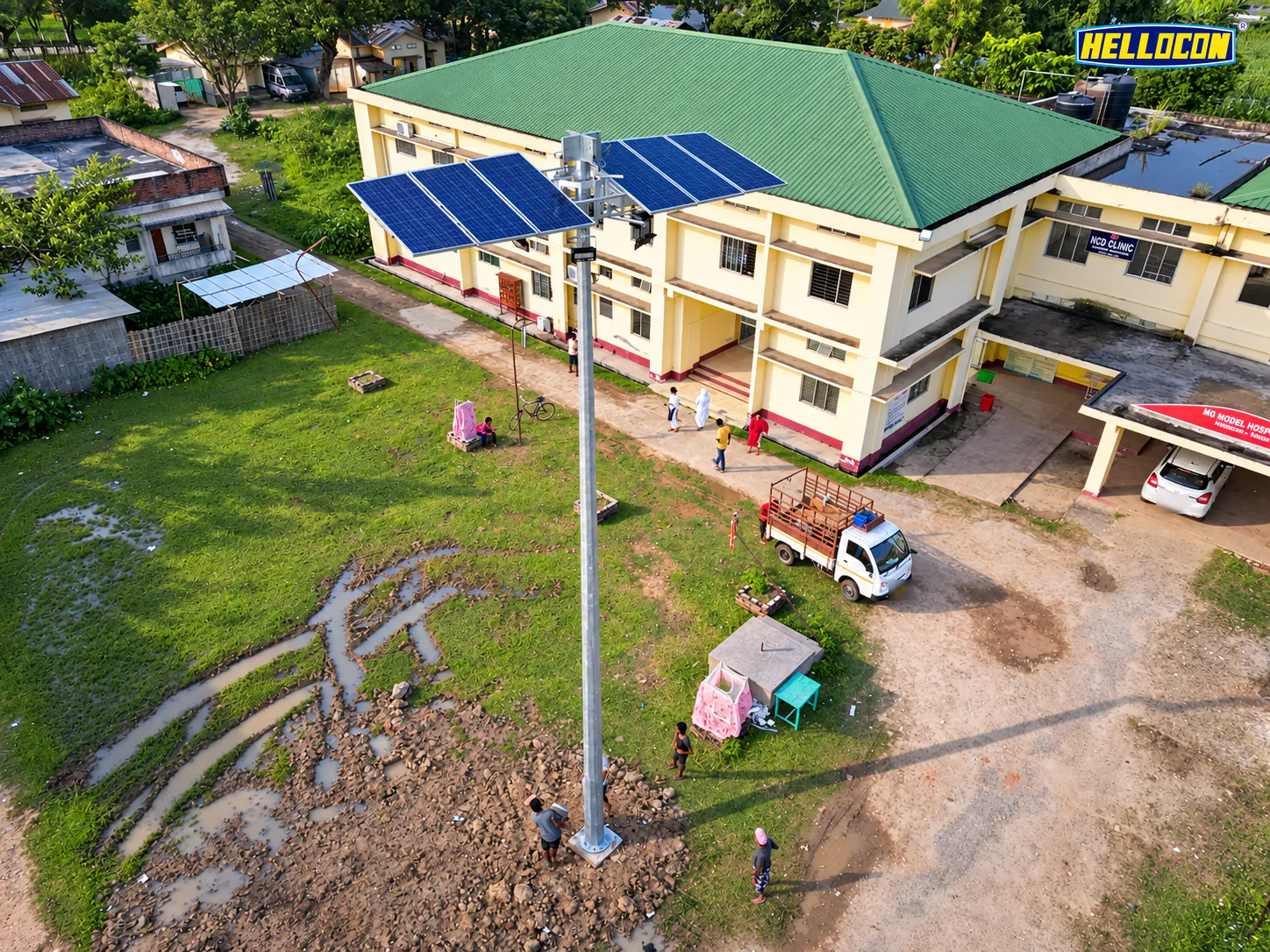
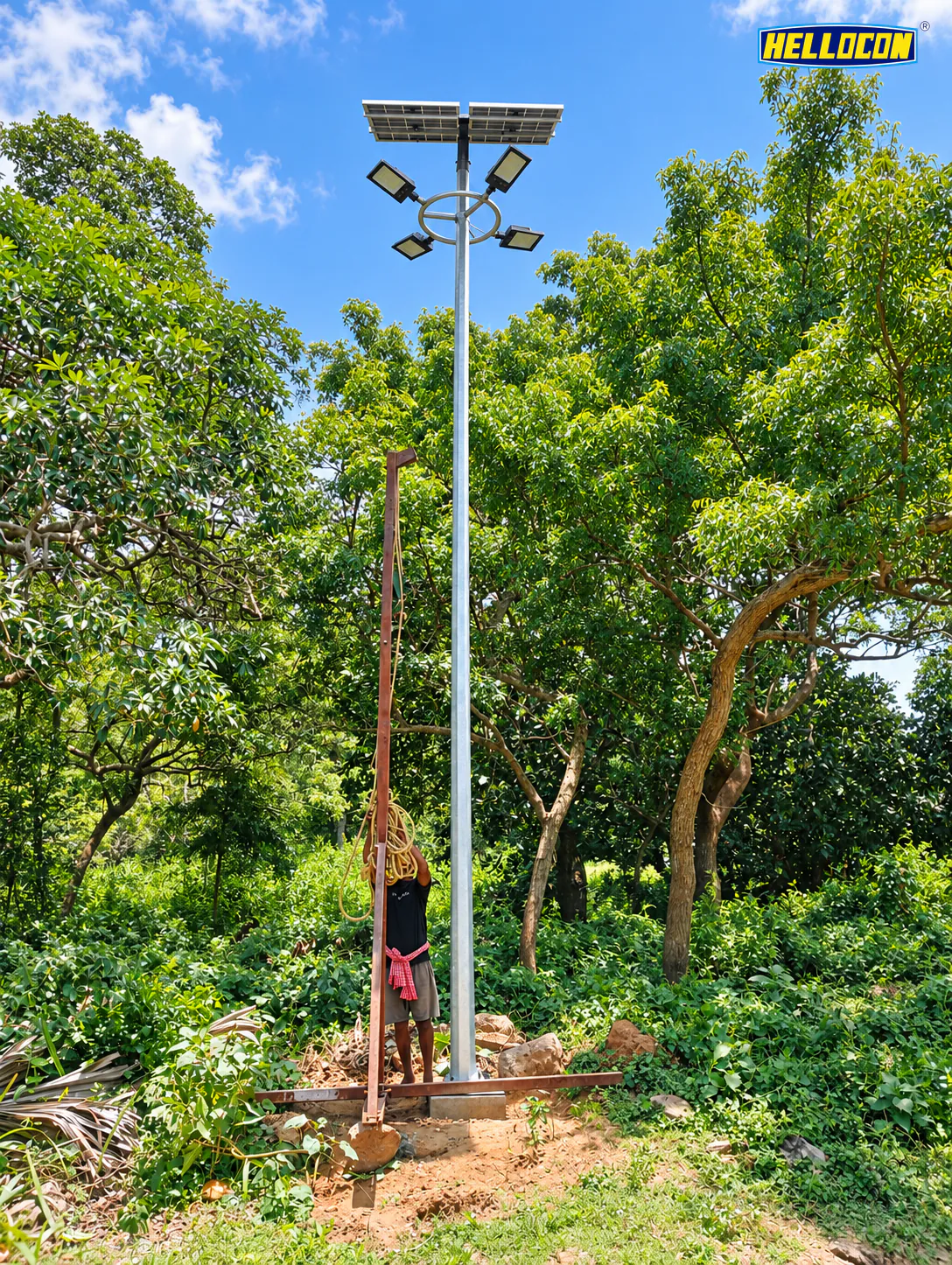
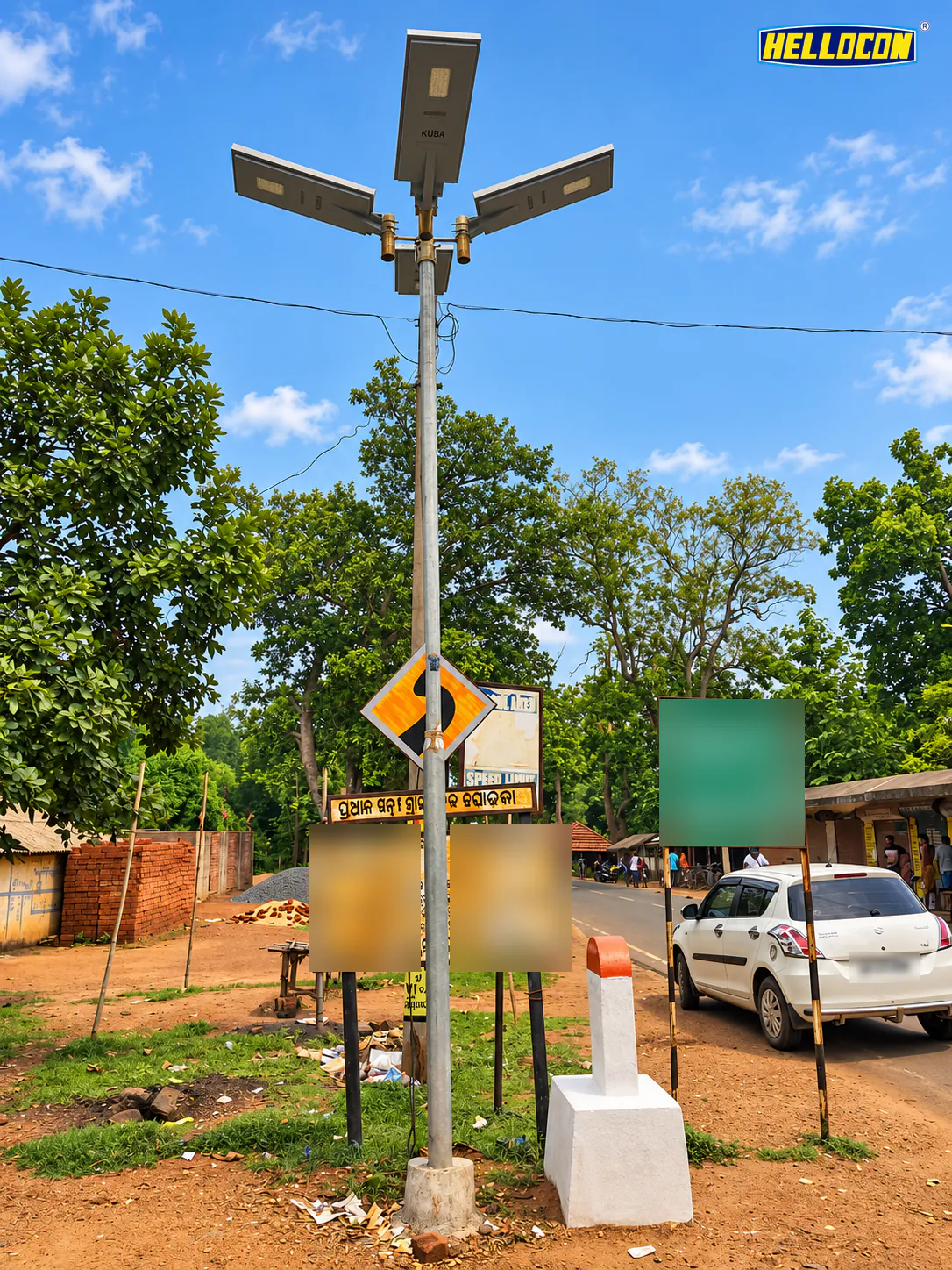
Solar high mast installations
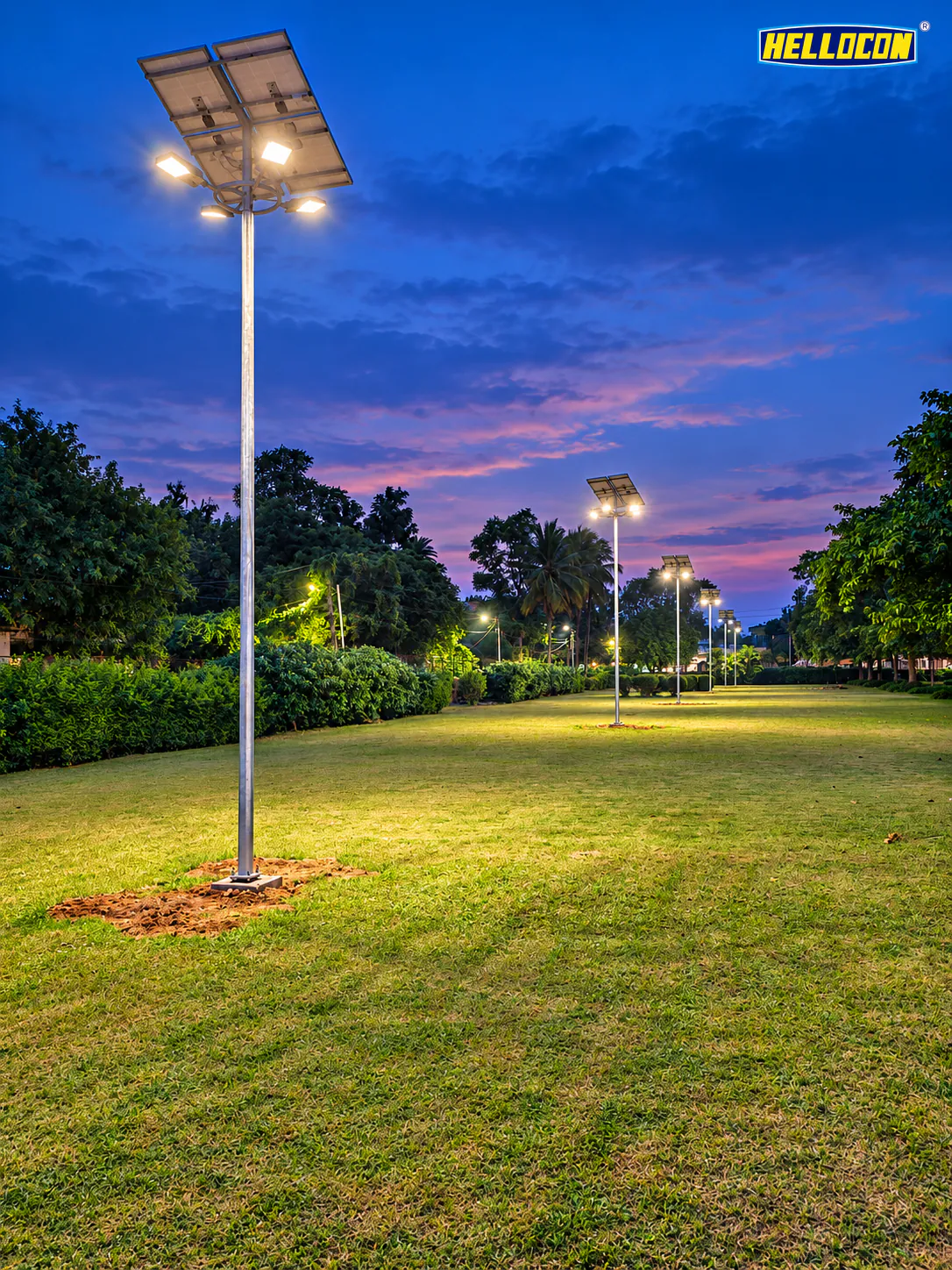
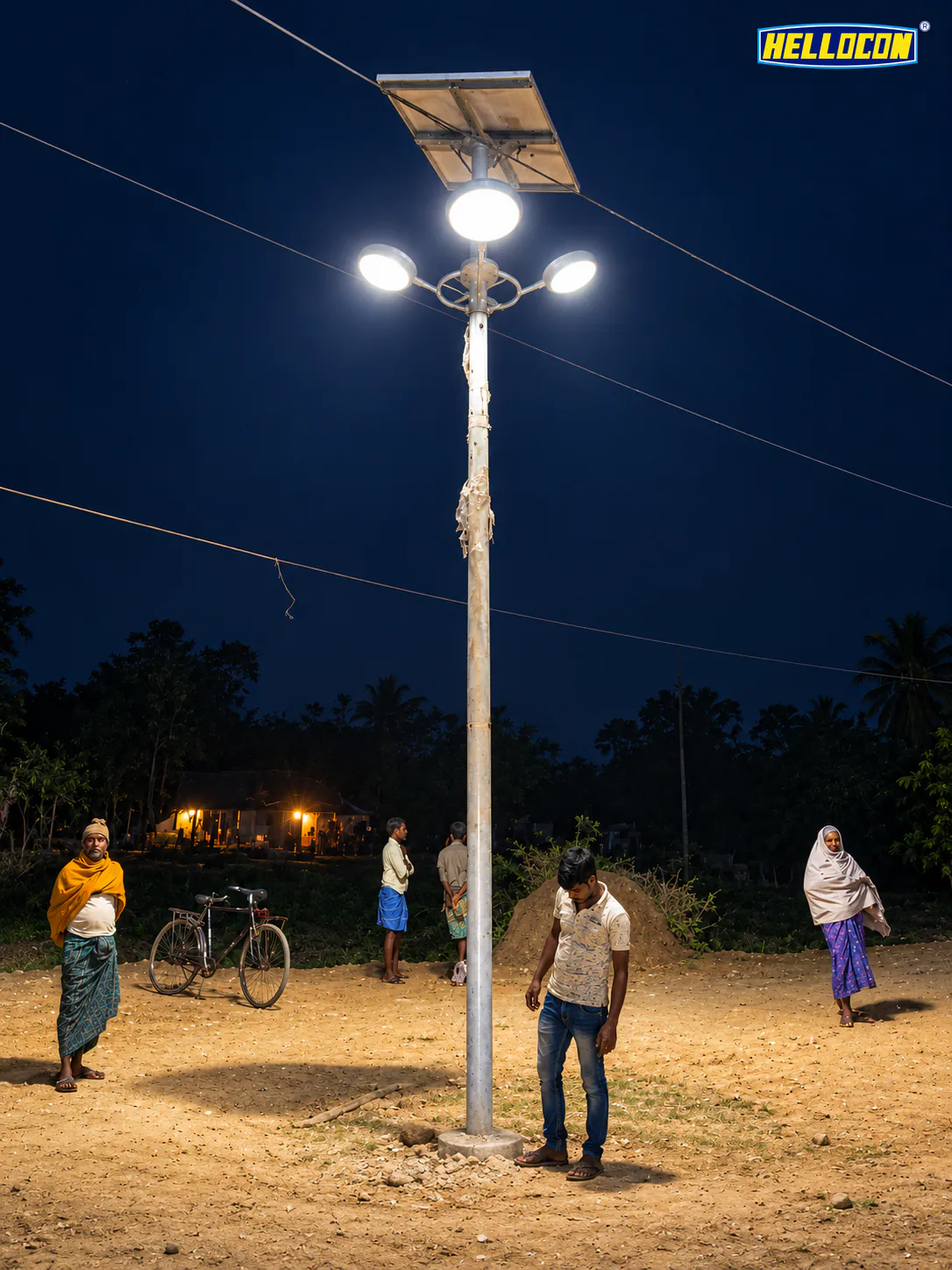
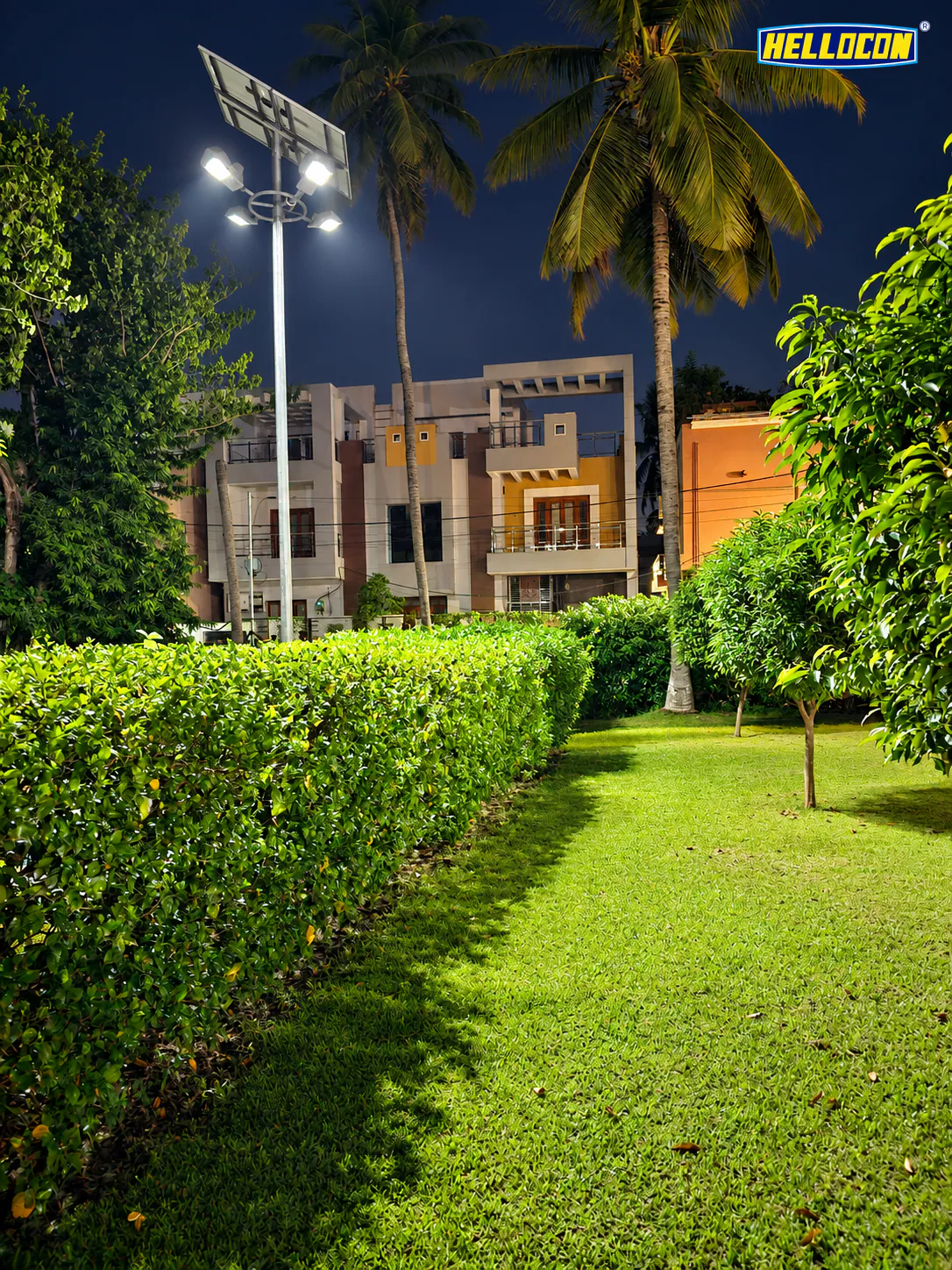
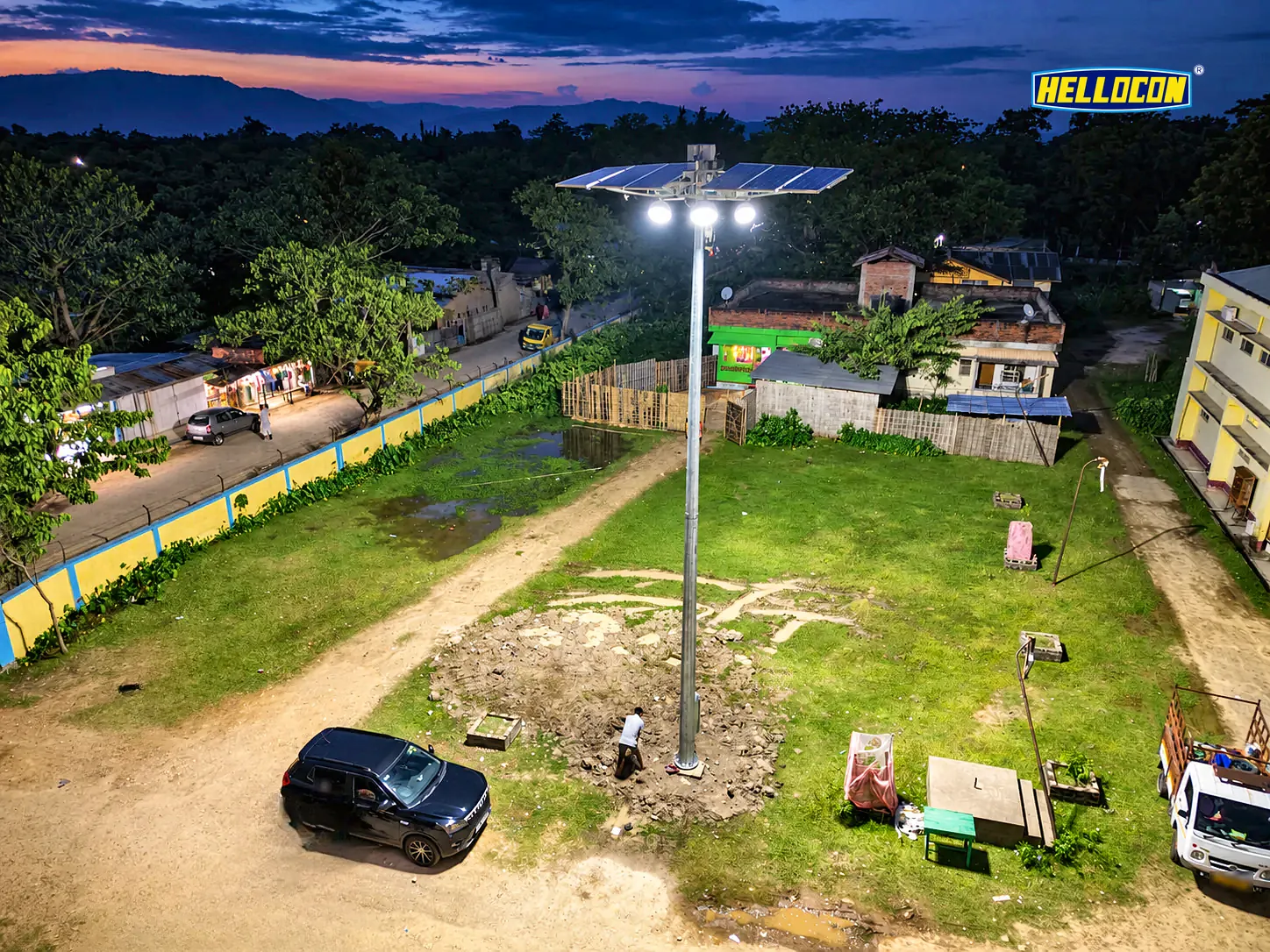
Photographs of HELLOCON solar high masts at a road junction, a village ground, a woodland site, gardens and parks, by day and at night.
03 · USEFUL TO KNOW
Solar high mast lights: frequently asked questions
How much area does one mast illuminate?
Coverage depends on height, optics, luminaire output, spacing and required light levels. A site-specific lighting study is needed; the interactive model is illustrative.
Does it run all night?
Operation depends on LiFePO₄ battery capacity, solar generation and the chosen control profile. Confirm the required hours and autonomy during design.
How many lights does a mast need?
The lighting study determines luminaire number, optics, orientation and output for the site.
Is taller always better?
Height should follow the application, structural assessment and required light distribution.
Can one specification cover every public space?
No. Geometry, activities, illumination and operating hours differ between sites.
How is storage selected?
Assess the actual lighting duty, seasonal charging assumptions and required autonomy.
Who designs the foundation?
A qualified project team must assess the ground conditions, loads and structural arrangement.
What belongs in the maintenance agreement?
Safe access, inspection, fault reporting, battery and luminaire replacement arrangements, warranty coordination and exclusions.
What is a solar high mast light?
An elevated mast carrying several LED luminaires, powered by a solar array with LiFePO₄ battery storage and charge control. It lights larger shared spaces such as village chowks, markets, campuses and junctions.
Should I choose a high mast or a mini mast?
A mini mast is a smaller area-lighting configuration for compact spaces; a high mast suits larger areas. The lighting study sets height, luminaire count and optics. Compare solar mini mast lighting and the lighting configurations.
PLAN YOUR SOLAR LIGHTING PROJECT
Request a solar high mast lighting layout
Share your location and the project brief. We will confirm the equipment and scope that suit your site.
- +91 88961 23453 · 0674 460 8185
- business@hellocon.in
- Every day, 9:00 am to 6:00 pm
- Head office: Bhubaneswar (opens Google Maps in a new tab) · Serving all 30 districts of Odisha
NEXT STEP
Plan high mast lighting for your public space
Share the area geometry, activities, required operating hours and the site location. A lighting study sets mast height, luminaire count and storage.
Every day, 9:00 am to 6:00 pmHead office: Bhubaneswar (opens Google Maps in a new tab) · Serving all 30 districts of Odisha